Mostrando entradas con la etiqueta English. Mostrar todas las entradas

domingo, 14 de julio de 2019

What happened with old pal Capolanda?

Well, it has been long. I updated the blog at the end of last year, but not for English readers. As I told on my last post, I got this job, that I still hold, and I still need the money. While I have left aside my personal programming, at the least it has helped to me to acquire some practical discipline and experience on a professional level.

And then, I almost died. Relax, it was just "almost". Basically, my heart had a congenital disorder that caused me an episode of arrythmia, a circumstance that has been my most painful experience ever, on the 2nd of December. At first, I thought I was having a heart failure, and after I warned my mother, we called emergency services. While I waited, I spent very, very bad moments. Finally, the ambulance arrived and they took me to the hospital. There I got various injections that caused me to vomit, which finally ceased the episode. And I spent the next three weeks and a half in the hospital.

Maybe some readers may thank me if I comment that, in Spain, health care is heavily taxed (social insurance, in other words) and I didn't have to pay a penny for this long internment (except what I have paid on taxes, of course). But, as a drawback, wait times can be eternal. I wasn't exactly sick, but rather at risk of suffering other attack that cold have led me to my grave. So, I needed to be performed a cardiac catheterization, where you take a very thin tube to heal people without having to cut their flesh. But, unluckily for me, the 6th and the 8th of December, both feasts in Spain, made a kind of holiday week last year, so it was the worst time to expect things to be done fast. So, I had to wait for a week for this operation, every second outside the shower with a telemetry to check I didn't suffer other attack.

Results? Half good. Although a vessel susceptible to cause tachycardia was indeed found and burnt (the medical team checked it because they artifically caused it), the same case of arrythmy that sent me to the hospital couldn't be reproduced. So, doctors suggested me to get an implantable cardioverter-defibrillator (ICD), and my bad luck wanted that there were reforms to install new material in the hospital that stopped me from having an MRI.

Why? Because in the future, the ICD, as it has a magnetic field, will interfere in the case I need one. So, I had to wait again, for a week and a half this time. Aside from being convalescent, I was pretty impatient at the start, but I resigned to my fate. Finally, I had the MRI and, finally lucky, I was implanted the ICD the next day. It was a short operation, but I spent that whole morning sleeping and I don't remember anything after I lay down on the operation table.

But I still had to spend even Christmas in the hospital and I didn't come back at home until the 26th. As you guess, I was on sick leave and I still spent the first month of this year resting. So, I am now a cyborg, but not of the cool kind from science-fiction, but actually weaker than the common man. Here you have some x-rays of various ICDs inside of people's thorax. Also, I have had to get used to this lump under my left armpit and to the fact that it keeps the object that could save my life under my flesh.

But, you see, you sometimes get over it. I had to admit that I have a chronic illness after a lifetime of not having anything remotely dangerous. I need medication, but as I have already mentioned, taxes help a lot and I only have to pay a small fraction of a cost that was initially low to start with. Once again, thanks to social insurance I received a communicator that sends periodically information of how my ICD and my heart are doing, along with a neat user's guide.

And still, I am happy that my only weakness is an equipment by electromagnetic induction, I could have died or become pretty crippled. So, after returning to work, I just continued living. By the way, we are testing this new schedule that will give us more free afternoons, so I think I can return to my personal projects.

But that will have to wait, because there are other things that will come down. Bye!

sábado, 1 de septiembre de 2018

Last biographic news.

Or, in simpler words: what about me. i dind'nt update during the first half of July because, in first place, I didn't know what to write about (I have various drafts, though). Furthermore, causing my most shocking surprise, visits remained stable for someboy as impopular as me. During the second half of July, however, a fact came to alterate my monotony: I had found a job!! This supposed the real end of a long period of unemployment, in addition of being a real worker for the estate (until now, I had done work emperience or under commercial contracts).

This, of course, has meant that I have to leave a little aside my personal business. For the moment, I can't say my profitable occupation is at the same time my passion, a situation that has come thanks to a combination of bad luck, the political errors of the last decade in Spain and some of my own foolishnes. However, I can't go on living at the expenses of my relatives and it will arrive the moment when i will have to get my own shit done, even only considering that self-accomplishment leads easily to self-esteem.

This shouldn't affect so much my news about future works. After all, since I assumed some project related to a friend, I decided to take some time. About posting in this blog for the sake of it, it will happen when I'm in the mood. Meanwhile, I'll follow my lead.

domingo, 17 de junio de 2018

My most recent projects.

Let's be honest since the start: I haven't worked in Thrylos since the last version. I had already explained then that the new released version of Godot was one of the reasons for the lack of progress of that prototype. The other reason is more obvious: Thrylos is based on a pretty open concept. It's better described as a game of games, which implies a great difficulty: I need to think carefully each of those games.

Due to both reasons, I decided to start something new for a change of scenary. This project is simpler, which implies a clearer way ahead that lets me focus better on my targets. I have also decided how to continue the idea, so step by step, I will finish it. I have already completed a big portion, aside from taking more advantage from Godot, which I exploited way below its full capacity.

There is, however, a great new in the fact that the project isn't only mine. The idea comes without doubt from outside (and other things) and it must be admitted that, while I'm doing the programming myself, the work also belongs legitimally to somebody else: to Mario Domínguez Soler. I'm basing the game in one of his characters, while at the same time it's a homage to The Revenge of Shinobi, a game I've always loved.

I'll inform again when the time comes.

Sources
Mario Dominguez Soler on Tapas.

viernes, 30 de marzo de 2018

Fourth version of Thrylos.

Well, it's here. This version brings languages, but it's notoriously shorter and lacks combats. I must admit thart a big part of the work has been dedicated to automatizing some operations not witnessed by players and to changing scenes. Other change that had an effect in my intention of introducing new characters was the stable realease of Godot 3.0 on Steam, which brings new favoured methods too long to list here.

I even considered not releasing this version, but I'v decided to do so for the only sake of the choice of language. ERASED due to personal reasons.

miércoles, 31 de enero de 2018

An example of good narrative in a video game: Silent Hill 2.

I take another break from programming and my everyday activities to discuss a bit of narrative in video games. First of all, here we need a good definition to speak with clearity.

A good video game narrative would be that where the game mechanics are directly related to the story. It is illogical, for example, for the story to herald pacifism and the risks of amibition if game mechanics rewards killing enemies with great perks. It would be a contradiction, where, however, some reknown examples have fallen.

But it doesn't stop there: after all, what a game offers is a match whose ending can change. In literature, there are examples of non-linear reading that can contribute to every reader getting their own interpretation of the story. The video game has introduced various possibilities to offer non-linear stories, although limitations have been the norm:

-The different ending may depend on particular story events, leading to bifurcations. This is made to make data saving easy and to simplify the involved algorithms. Thus, this system makes people to save the game just before the bifurcation to obtain so the different endings from that point.

-In other occasions, those endings are activated by finding objects, so it rewards occasional curiosity reather than a constant tactic, for example not killing anyone.

-Regardless of the method of activation, this kind of divergent stories are usually rated as "good ending and bad ending", to say, some of them are considered better for whatever the reasons: because the damsel in distress isn't dead, because the true boss of the bad guys has been defeated or, less frequently, because the main character is considered to have commited a moral transgression during the adventure. The truth is that these kind of menas are seldom alone, being one the predominant. Anyway, the very ending hierarchy doesn't make the so called bad endings an attractive option, as the developers themselves call them, because they are failures.

One of the reasons this system came to be questioned was Silent Hill 2. Since it first appeared for PlayStation 2 in September 2001, it updated its predecessor in both mechanics and ending interpretation. For the first part, it made use of a system similar to that of certain RPG based on Dungeons & Dragons: saving various scores, according to how the player acts at numerous events, instead of saving the result of only one.

Now, Silent Hill 2 took a giant step forward, because these events were apparently random actions. As a general norm, RPG save scores according to thow the player acts at a mission. Here, however, the attention was in things such as spending a lot of time with a female character, observing a useless knife or even keeping the main character health in good or bad state. Here is the FULL LIST of these elements.

About the interpretation of these endings, it is interesting to say that it can't be said that the best ending is good (not related to the better is the enemy of the good), because it is fair to say it is pretty depressing (without spoiling the plot, it is). The ending that depends on finding hidden objects is very sinister, as it supposes a pact with Lovecraftian forces in the best scenario. The other endings are even sadder that the first, and that's saying a lot.

In the same webpage I have linked, you can read about other Silent Hill games that were pretty innovative, specially the third. Whaterver the case, Silent Hill 2 endings are one of the many reasons to propose the game as one of the best games ever (I had written the former sentencce in such a way it said the game "was" good, but I have corrected it).

martes, 30 de enero de 2018

Gangsta. Everything bad in anime is here.


Gangsta. (yep, it is written with a dot) is a manga belonging to seinen demography (young adult), halfway between noir and science-ficiton. As at home we have subscribed to a monthly offer of series and films, I decided to give it an opportunity. Furthermore, I have spent some years far from anime. This series tells the story of Worick and Nic, a pair of punks to rent from Ergastulum, a prototypical noir city that would never appear in a tourist guide. Nic has superhuman strength because he is a twilight (the Spanish dub maintains this name), suffering however a reduced life expectance (so, "twilights") and certain physicald effects, Nic is himself deaf. I didn't find it a bad idea, but while I was watching it, I noticed everything I explain hereafter. While I don't spoil the whole plot, maybe some readers won't like reading it if the prefer watching the series before.

Plot finishes on a cliffhanger
The relation between comic and animation is interesting. In Japan there is a strong tendence to transform in series or film every succesful comic (and even video games). In that place called West, a term that is a pretty broad generalization, isn't the case. In fact, it can be said that, from some decades ago, Western comic has lost the popoularity it enjoyed in other times, which has made it to become specialized. In other words, it has abadoned mainstream. The proof relies on the medium difficulty to name a recent and popular comic not belonging to a publication that started quite a lot of decades ago.Very likely, that comic will have an animated adaptation that has made it famous. Franco-Belgian comics in francophone countries are the only exception.

About animation, it is sometimes said with a bit of sarcasm that in the West the only valid paradigm was Disney-Pixar for all audiences, while the one not addressed to children (be aware that I am not saying adult) is either The Simpsons and its clones (also known as "Seth McFarlane's series") or South Park and its clones. There have been others, of course, but they were generally minoritary. Nowadays, we can enjoy Adventure Time, Avatar, Bojack Horseman and Rick & Morty.

In the case of animated adaptations from reknown comics, there have been both good and bad. The series of Batman: The Animation Series is revered and the classic Peanuts adaptation was also pretty good, while other adaptations have been pretty unsucessful, so I shall not mention them here. In other countries, such as France or Spain, it was the same case, sometimes almost better than the original.

Anyway, one of the clearest features of Western adaptations is the independence of plot and related stuff. It is somewhat obvious when the original work has been running for some decades, who could adapt so much material? But in Japan it is not usually the case, actually adaptations follow the progression of the comic plot almost to the letter. For two reasons:

-Japan is the model of a consumist country. It shows a clear tendence to rate novelty over almost every other consideration. So, as a general rule, adaptations won't wait until the comic has finished or at the least there is enough material to do a good adaptation, but the latter is considered another way of advertising.

-The studio is not always working with all their efforts in the project. It is unknown both when it will finish and the plot is not conveniently adapted.

And, here, at the least it has been the latter: the story suddenly gets cut when the city of Ergastulum is at the break of a civil war with genocide rising. Who knows how it will finish! The creators consider that, in the scenario where the series doesn't continue, credit for the comic is guaranteed... But from a perspective of the series like an independent artistic work, it can't be more pathetic.

Of course, it could be argued that an original series may cease suddenly, may it be animation or not... But in Japanese animation it has become the norm. Only adaptated films offer really conclusive plots, due to force majeure.

Another possibility is the author's pressure: comic authors can be almost as intolerant as novelists with a speech bubble, as there are no commas, being removed from their original work. A disaster anyway.

Characters' construction
A topic to create an edgy character is developing a tragic past (that was my first option to name this section). As this anime is a bit noir, it is not strange. And be aware, this is not necessarily bad. The problem appears when it is the only thing that the character has. It is the case of the deuteragonists, with the too familiar revenge, with neither their relation being original nor developed in a convincing way, too. Maybe the comic has more, but it isn't here. Indeed, their present lives are more interesting, Worick himself is a gigolo in his spare time (it must be admitted this is pretty a novelty).

Then it is Alex, the typical good-hearted whore exploited by a wretched guy; doctor Theo, who wants to ve independent and help anybody (Damned Japanese and their lack of social security!), officer Adkins, the only honest policeman who has to work in a city ruled by four crime syndicates; and others like that.

Now we must talk about young girls. It happens that Gangsta. features two very young girls... and at the least one case is slightly weird. I don't find Loretta Christiano, leader, after her parent's death, of the most benevolent syndicate among those that handle Ergastulum business, strange. I do find Nina, doctor Theo's nurse/apprentice, strange. Maybe it's me, but I would say she is horribly young.

She is. The wikia says she is twelve.

I can imagine that Ergastulum may lack public education (Maybe even one compulsory!), but it still surprises me. She may be gifted and that's why she is learning medicine at such an early age, but I can't give up on the suspicion that it's an excuse to present a loli... Anyway, at the least plot doesn't sexualize her innecessarily (I shall speak of that later).

It isn't like that for Loretta, who in a given moment puts off her clothes in a room with some of his hitmen because she decides so, when she could have gone into another room and changed clothes calm, without making a scene.

About the themes, we've said that in this world there are superhuman beings called twilights. They appeared after certain war that is only mentioned superficially, in what certain serum was tested to obtain soldiers doted with superstrength. It was too successful, as the doped subjects suffered mutations and the effects got permanent, transmitted also to their descendence. Like Marvel mutants, they face discrimination and racial purists. In fact, Ergastulum looks like Genosha, because in the past twilights were enslaved until, after various riots, being given their freedom back. This point is treated with correction, though they could have used less time to explain it. Furthermore, as the series finishes suddenly in chapter 12, we don't know the exact circumstances of this manumission.

That said, it's fair to state that Nic's deafness defines him as a character and is useful to expose the communication problems between him and Alex.

Irregular animation
And we use the term in its most primary meaning: lacking regularity. Some chapters show a high level in animation and others are pitiful even for a simple background shift. The same happens for fights: two are animated in a pretty awesome way, but towards the ending everything is resolved by the hateful method of the frozen image and characters so fast that their movement isn't visible.

The frozen image is a bad technique that Japanese animation normally uses: it consists in showing the scene like in a comic, with nobody moving, sometimes not even camera. For adaptations, it isn't unheard to take a panel coloured for the occasion and, maybe, with some petty movements, but unchanged for the rest. And of course, it doesn't work. It creates a terrible feeling of cheapness. Some studios seem to believe that, as both animation and comic are drawn media, this technique is permitted, when they are different media. Good grief! THE NAME IS ANIMATION FOR VERY GOOD REASONS!

Fanservice
Let's first speak clear: I don't think fanservice is bad. No. Nein, non, niet, HELL NO! Indeed, I like it. I'm Spanish and, like most of Europeans, I'm more familiar with nudity, comical or not. In that sense, I have always been marveled by American puritanism around this point. Indeed, you can look for some recent censorship by Facebook of a historical magazine cover: when Marisol appeared naked on Interviú, which is very important for these reasons:


My position in fanservice was reinforced by the fact that manganime was a clear defender, what made me even more familiar. The bad thing may be in how it is introduced, as it's the norm with everything. An erotic situation may either be justified by plot or be forced without taste.

Here come two examples by Rumiko Takahashi, one of my favourite comic authors ever.

Ranma 1/2 7: The Soap of Happiness at MangaFox.laRanma 1/2 7: The Soap of Happiness at MangaFox.laRanma 1/2 7: The Soap of Happiness at MangaFox.la

Why do I consider this scene well introduced? Simple: it happens in a damned public bath, and in public baths, people are naked. And here is the second, more illustrative because the horny guy is the monkeybuttt.

Urusei Yatsura 3 at MangaFox.laUrusei Yatsura 3 at MangaFox.la

Nobody dislikes a sweet... The problem appears when nudity is present or breasts are mentioned when it isn't the best moment. One of the problems of manganime in the 90s was the continuous scenes in baths. Nowadays, nevertheless, even that excuse is ignored, remember waht I said about Loretta earlier. To top it all, in Gangsta. Alex can't speak to other women without being told that her rack is fantastic, except in two occasions. Maybe Ergastulum has a taboo against speaking about weather. It's even worse because Worick, representing male fanservice, makes it natural: in bed, when rain wets him or when he is changing clothes.

Spontaneity isn't exclusive for a gender. At the least, that's my opinion. But the worst, aggravating the innecessary fanservice, is the cowardice. There was a time when manganime only censored genitalia, but it must happen that, in order to make it acceptable for American audiences, they have adapted porn that isn't porn.


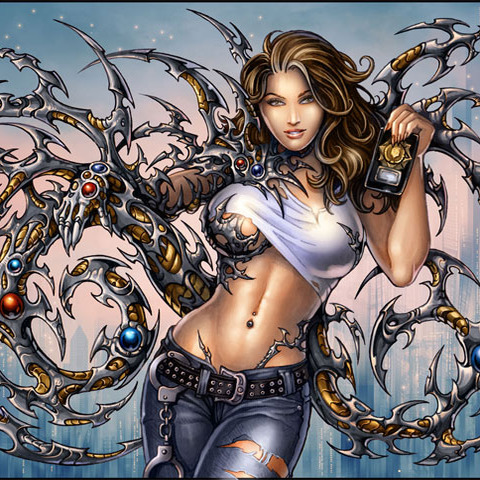
Witchblade almost encarnates the concept.

So, in Gangsta. we don't see nippes, but braless women whose whole breast is visible, escept for the nipple. Just observe the next example to finish this section.


Ridiculous, huh?

Action
Well, this story features superhuman guys: as a seinen, Gangsta. needs to explain their power within science-fiction. Here, people can neither fly nor spit beams through their mouths. Even twilights' awesome physical skills respect physics until some point: if a strong, but of slight weight, character is hit with enough strength, they will fly under the second law of Newton, even if unhurt. It is also nice to not see typical manganime bullshit such as "OMG! He's charging towards me with his dynamic ball-reversing blow of geez!".

Similar to Yū Yū Hakusho, twilights are classified in levels with letters and numbers. They're required to wear tags with the aforementioned level and their data, so they're also called tagged.  Power levels as a narrative tool can be confusing sometimes, but it's fair to admit that they generally work. Furthermore, this level doen't exempt physical constitution: giants are usually strong for their level while dwarves are fast, specialized in stabbing with knifes while jumping and running around.

Of course, as a good anime, almost all twilights prefer using melee weapons in a goddamned world where handguns and rifles are present. It's OK when they face normal, standard people, it's cheaper, but it's a nonsense when they face another twilight.

To add salt to the wound, the twilight deuteragonist, Nic, is "Asian" (well, the Spanish dub says "asiático") and patrols the streets with a katana, which he rarely pulls away. I know this is a Japanese work and that they love their culture, but all the samurai/rōnin motiv is becoming a sad stereotype! Western heroes, I must say, show a wide range of weapons and tools.

But, hey, it could work... Then we find a supreme cliché: David and Goliath, featuring an enormous black guy (there is a bad tendence to represent all blackmen as enormous...). And the guy comes up saying about Nic:

"Bah! He's a dwarf."

And I thought: "This guy is thrashed". Well, you see, when the same motiv is used approximately one thousand times, it can be said it's very predictable. Of course, Nic wins from the moment his level is revealed to be higuer than the mountain's one. That said, I would lie if I said the fight is badly animated, as I would lie too if I said the same of other fight later. They're very likely the best animated bits in Gangsta., with the first chapter coming along.

But when reaching the end, everything becomes the same old archetypical plot where manganime seems to revel ad nauseam. First, we discover that Nic has a very high level because he has defeated very powerful foes, but, while fighting, is doped with the drug twilights need for their health... So he's really weaker. This is an already hateful mechanism: the main character always has transformations or objects that augment their strength during limited periods of time, al the cost of becoming weary later. However, their rival is always strong by himself, without needing to transform in supersaiyajin or whatever the hell. That's why some of us have a preference for Piccolo.

Maybe those weren't enough topics, so another, such a wild Pokémon, appears: a new kind of punks even stronger that twilights, without twilights' weaknesses. And, oh, the humanity!, they're worse than a novel by Dan Brown. It's lucky they only make their first appearance in the ninth chapter and there was little more, because I'm already too old for this nonsense. Because, I wonder, where is poor twilights' drama now?

This point could have been discussed in the former section of character's construction, but here it is better explained: lots of seinen aren't "adult" at all, their plots look a lot like Dragon Ball and One Piece, with junkies and whores making the only difference. Maybe the manga explains it, because in any case, as I said earlier, the plot is very badly adapted. When something fails, it isn't strange to see the rest of the work to get impaired

Conclusion
Gangsta. has very good points, such as a deaf main character: disabilities aren't always presented in manganime. The noir appeal is usually an inteligent election when a science-fiction story hasn't been thought to be speculative or social. Main characters aren't badly designed, too. Sadly, it's yet another case of the symptoms that Japanese animation industry suffers, lost in a stagnation of mannerisms and navel-gazing.

Notes: Images has been obtained from wikias of Gangsta., TV Tropes, Mangafox, Witchblade and YouTube, in that order.

viernes, 29 de diciembre de 2017

Reflexions about this year.

Let's see:

-I have published up to four games. Three of them are prototypes of the same project and the fourth was independent. All of them are found on the side column.
-I have polished my informatic skills with two programming languages.
-I have thought about the background of my sci-fi stories and have written a lot, still centered in experimenting so I could see which effect the narration creates.
-In this blog 33 posts have been published, including this. Especially, because it is bilingual since June.
-I have had talks with other fans and authors, which it has been useful to contrast my opinion with theirs. In general terms, we agree in some points about how things are marching in the scenes of comic, of animation and of video games.

It has not been bad, but I must improve and step up.

sábado, 23 de diciembre de 2017

The third prototype of Thrylos! Godot for both good and bad.

Note: I erased the link to the game due to personal reasons.

Without any delay, I must admit that working with Godot has made things quite better. In special, animation has gained quite an improvement and it's one thousand times easier to create new elements and add them to scenes if wished... But there have been some minor problems. Blowing hot and cold, to be fair.

-In the case of Pygame, I myself created the elements and, while it was pretty annoying, at the least they worked like I considered better. However, Godot Engine includes its own collection of objects that hasn't always worked like I expected. I repeat that I hadn't any previous experience with engines thought specifically to make games.

-The former point has affected slightly the movement of boxes, that will need a new adjustment and in fact in this game they are exempt form certain situations. It also affects texts, which notoriously are only shown in a size. This happens because Godot doen't allow to change it unless you import a new one. That said, I hated the one I had to use on Pygame.

-Saving data had a strange issue, as I comented when I published Terror Story. But I have found an easy solution.

-As I have preferred to publish the present version before Christmas, there are other simplifications, such like enemies only detecting the character if it's in front of them. Other aren't notorious. After all, I had to check a number of things before making anything consistent.

Anyway, I can say the next version will be A LOT BETTER. What I have learnt will allow me to create something pretty more palatable, without a doubt. Here is ERASED, also present on the side column.

Erratum.

Before we start, my apologies. When I created Terror Story, I was on a hurry and I dind'nt realize that I left behind a file therically useful to make conversions (that file, besides, wasn't really necessary). This file took up an absurd memory, 210 MB. That's why I want to have an opportunity to relaunch Terror Story, erase the old link and, furthermore, now it can keep data correctly.

Of course, I update the original post and the link on the side column.

lunes, 30 de octubre de 2017

The Test.

Note: I erased the link to the game on 14/12/2020 due to personal reasons.

I'm no quite fond of challenges. In fact, there are few things I hate more than doing the same thing all day long. Thus, when I willingly face a challenge, I know well I won't deal with it all day long. So, I aimed to do a functional game for Halloween. Quite a simple game, to be fair.

But that wasn't my true intention. Although I'm not fond of challenges, I am fond of putting myself deadlines because I know it's the best way to make me fight for getting an objective. During my first steps with Godot, I focused on getting familiar with the physical features of Thrylos, my first game, especially because Godot distinguishes various kinds of objects and it's necessary to deepen to understand how they work... And, still, I find strange behaviours needing a review.

Whatever the scenary, I had been unattentive to feaures such as menu creation, cinematic scenes of transition between stages, loading and saving data (which implies loading and saving games), pausing the game and sounds. In general terms, I can say all of them are pretty easy in Godot, which is obvious as it's an engine thought to evade nasty complexities. So, I've already become familiar with such five important features.

But there are problems related to the system of loading and saving data, only for thw Windows version. I don't understand with a perfect grasp why is happening, but it seems that, once you've played it, data becomes "fixated" without possibility of changing it, except if you erase the game and download it again. I'll have to study what exactly happens.

About the game, it isn't spectacular at all. I've just implemented two or three silly things. In cinematic scenes, characters only speak. I've included no action to evade impredictable and too complicate behaviours. The plot shines so much as it's absent (loose translation of a famous Spanish saying).

Anyway, may it remain here and it will always support me for future deliveries. The file name is Terror Story because it was its provisional name. I have versions for Mac and Linux, too, but I don't find it ethical to distribute files that I haven't tested previously.

Stop presentations, here is the ERASED. Be fine!

P.D: The link was changed on 23th December because the former file took up a ridiculous portion of memory.

martes, 24 de octubre de 2017

Forgotten gems.

I was giving my evening walk when, at coming near to an electronics shop, I saw the recent Super NES Classic Edition was sold there, more known as Super Nintendo Mini (due to, among other reasons, my farewell to video game consoles during the last breaths of PS2, it's been long since I trod on one). I stayed watching the display window for a while and I continued my walk, while thinking about the limitless success of the 16 bit generation, able to sell even nowadays.

As I got interested, I decided to check which games were included. The article on Wikipedia informed me that the Japanese version and the International bring different games. This made the fact that quite many games aren't known outside a country, in this case Japan, to stick in my mind. And that made me remember Moon: Remix RPG Adventure.

It's very likely that the reader, even if doted with a good knowledge of video games, doesn't know what game is, except if it's Japanese or has a good knowledge about games that didn't make it abroad. Moon: Remix RPG Adventure appeared in Japan in 1997 for the first PlayStation and ows its fame for being, to say it subtly, a hard parody of the Japanese concept or an RPG. Because, in the same way that in Spain some ignorants with a degree (sometimes called journalists) believes these games are part of Satanic rituals (1), in Japan the concept of an RPG is very ligated to one of the electronic adaptations of Dungeon & Dragons, Wizardry. In particular, to the gameplay Dragon Quest and Final Fantasy inaugurated in their time, as well as the rather melancholical plots that made the latter saga notorious.

Moon: Remix RPG Adventure, as it indicates the linked article, doesn't only parody this kind of gameplay directly, like the more recent Like a Clockwork, but it also show us that art essence is construct again the sand castle and adds a story original for what the standards of Japanese games then. With a quest structure already known in western RPGs and a strong pacifism, the game stands for treating NPCs like individuals instead of considerating them as generic. The articles explains better than me what makes the game notorious.

I've never played Moon: Remix RPG Adventure, but without a doubt it's an attractive idea that really deserves an opportunity. Indeed, I knew about this game in its time through a brief comment in certain magazine. Nevertheless, it never came out from Japan. Love-de-Lic, its creators, also count among their works other two creations, even more unknown: UFO: A Day in the Life and L.O.L: Lack of Love (2). Neither came out of Japan and, furthermore, the second appeared on the prematurately abandoned Dreamcast. Both of them look even stranger: the first consists of searching aliens and the second is a kind of sandbox whose only goal is living, making various actions such as cooperating with other creatures, eating them or even something as basical as urinating (note the formerly linked article speaks of other game with a button for the said excretory function). In 2000, however, the company dissolved.

Anyway, they're interesting games. The problem is that none of them has seen again the light of the day. Moon: Remix RPG Adventure has been privileged with no less than two translation teams who have tried to adapt this great work to English. But no word has been said about a remake for either a modern console or PC. In part, it's logical since all works by Love-de-Lic have fallen into a legal vacuum after its disappearance. In its own way, it worries me, because it implies forget a fragment of video game history. Of human expressions, video games are one of the most affeced by obsolescence (either intentionate or not): home consoles get surpassed and old PC games need patches to work in modern operative systems, too.

The mentioned Super Nintendo Mini, just like the slightly former NES Mini, works with an emulator of the original home console created in a Linux system. Something similar happens with Moon: Remix RPG Adventure, which needs an emulator of PSX to work. But there's a difference: these emulators are creations of fans and lack a brand, to put it simple. And, incredible as it may be for free spirits, lots of people ignore anything unbranded. And little is done to teach video game history.

In Berlin, a video game museum exists. One of its most notorious incentives is the fact that it allows to not only observe, but also to play in the original machines and to understand gaming twenty or thirty years ago. It's quite good, but the problem resides in that you can't always go to a museum. In the same way that we admit reeditions of literary classics, although their authors were never able to enjoy their profits, we should admit official reeditions of electronic products and readapt them to new devices.

Of course, it's impossible, due to the very legal vacuum that allows the existence of ROMs on Internet. Who's the actual owner of Moon: Remix RPG Adventure? And what happens with its artistic features, like storyboard, graphic design, music, dubbing...? And so, for a great portion of the audience, they reamain unknown, to be enjoyed only by collector and those interested on the little ROM world. Very sad.

1 Short summary for foreigners, who aren't likely to know about pre-Internet Spain: In Spain, there was a disgraced murder, in whick a bastard and an imbezile killed a poor gentleman who was waiting for the bus. Later, it joined with another murder, caused by a supposed addict to Final Fantasy VIII, and later thanks must given to media ability to throw rubbish where it isn't needed. This why RPGs still have among some slick-haired people of serious speeches, actually ignorants with just looks, an air of macabre entertainment, to use an expression that could go out from their lips, proper of murderers and sectary groups.

2 I have observed that the authors are obsessed in the structure Noun: Noun Syntagma for the titles of their games.

lunes, 16 de octubre de 2017

Those damn achievements!

Since ever, videogame fans have had the idea of better and worse outcomes when playing a game. Defeating the final boss without having been hurt not even once isn't the same as coming out totally screwed. The idea of a game with handicaps is also known: defeating the final boss without jumping or without using certain weapon, etcetera.

Some video games include a recognizement if that happens. As an example, in various fighting games it's possible to fight a secret boss only if the game end is reached without losing at all and with good results. The next video explains how to fight Shin Akuma in Street Fighter Alpha 2.


That's the first kind of achievement, the easiest to understand. Of course, some examples are especially difficult. For example, all those about finishing the game without dying once. The necessary training is made up for if the player is really interested in the game.

Next comes the one that could be called "curious": you do something that is somewhat unusual, because it's outside the normal course to progress in the game. Such it was in some Final Fantasy games, where monsters under the category undead died if the object to revive is used on them.


The third is a derivation of the Easter egg: a secret hidden somewhere in the game. It's easy to miss it because it's pretty well out of sight, but if you find it, it's an achievement for you. The very first Easter egg ever is perfect to illustrate this point (9:32).


And then there are... the stupid achievements, to be fair. Achievements that make no sense, to be honest, and almost impossible to get without a guide. Some are so nonsensical as, like a certain visual novel, to leave certain scene open during an hour and a half. Seriously? Who is so patient? It's clearly thought for the guides, it's also as uncomfortable as a pain in the ass.

The other modality of vain achievement, though not stupid, is ligated to get achievement just for advancing in the story. I find them logical if the gameplay has diverse routes to follow, but when it's linear, what sense does it make? It'd make sense to include one achievement for finishing the game, because it's obvious you need to surpass the first levels, am I right? I only found it sensible when the game has an open structure, without levels, which can give players an idea of how much they have advanced... It may not be welcome, though.

And, of course, it may happen that the player isn't interested in those achievements, specially if they're too strange. I don't know, but do I really want to go drinking with one of the developers IN REAL LIFE?

Of course, everyone can play as each likes. Ignoring achievements is a way as any other of playing. But it wouldn't be bad if some developers considered just for a moment their ideas before implementing them...

miércoles, 13 de septiembre de 2017

Last news about Thrylos.

Some aren't good, I fear. Others are fantastic!

I tried during summer to make some editors for my game. The problem is that I understimated the difficulty of the job. I have been able to make one for levels, but that's all. In short, it's due to the combination of having had less time to use the PC, of not refraining from thinking complicate scenarios and from having too much fun (Trails in the Sky, ahem!).

I have had this tendence of thinking in complicate situations, likely because I think that Thrylos would be great with a good level editor. However, my ambitions were too high and it's also fair to admit that I put myself a shorter deadline in the least recommendable situation.

But there are good news too. After testing it, I have decided to use Godot Engine. When I felt somewhat hesitant about if continuing with the other editors, my friend Daniel Robledo revealed me its existence. And it seems to work quite fine.

I knew about engines, but I wasn't very determined about which one to choose. However, this one is pretty recent (Godot 2 reached stability in February of last year) and the first things I found on the net were exactly the same things that had left me frustrated. Both facts made me feel inclined to give it a try.

So, it's mandatory for me to work in this until I can get a new version. For the moment, I can say the game is way better animated in Godot and I'm reaching the point that I achieved with Python. These years have taught me the basics of programming, which I can continue putting into good use. Also, Godot Engine includes 3D and it's a good moment to start. Pygame isn't really designed for 3D, so I was considering Ogre engine as an alternative.

And so, I'm back at work...

P.D: I use MacAfee and it detects, for some reason, the download page of Godot Engine as a dangerous one. You can download Godot from Steam (that's what I did), but I think it's better to give this adversiment.

martes, 15 de agosto de 2017

Worthy comics.

Not long ago, I read a comment by Irene Roga (in Spanish, though) with a protest about, when people name their favourite comic, it's always one with serious undertones: Watchmen, Maus, From Hell, Paracuellos (1)...

"Paracuellos isn't only a serious work, even if quiet a lot of the content makes you feel like crying."

Correct, but I think my point is clear. For non-Spanish speakers, Irene Roga defended comedy as a worthy genre, in spite of the terrible attacks of those selfish and egocentric subhumans called hipsters. Indeed, it's fair to admit that it's a fight worthy of a Schillerian god, because the idea of comedy as a minor genre is pretty extended. In the Oscars, it's been years without a comedy winning the award for the best film because we live in a SERIOUS world. Humor is ussually appreciated in literature if it comes with a satyrical, even misanthropic, spirit. A funny, silly novel, without a heavy social criticism or even with some directed towards the serious gentlemen of literature, may go unnoticed.

Anyway, I'd say that, when it comes to comics, there isn't only a problem with humor, but there's also other with the publication format. See: traditionally, comic as a medium favours a exclusive time, where particular stories are more important than the global continuity.

The best example is The Simpsons: in this TV show, what counts is each episode and how it's resolved, but there isn't and will never be a very strong continuity. That's why none of the family members ages (2) and Springfield is in nowhere (I wouldn't find it strange if there is still a geek trying to resolve the enigma), it's just a "typical" American city. As a family, they need neither a start nor an end.

Mortadelo y Filemón, Zipi y Zape, (3), Urusei Yatsura (whose adorable main female character presides oveer this humble blog), Ranma 1/2, almost any superhero comic are other examples: virtually all of them feature the same "time loop" that forces the characters to be still the same age although the time flies for everything else. Superhero genre is distinguished by the retcon that updates a character's origin every few years. Furthermore, these stories are usually composed through a kind of accumulation: each chapter adds new anecdotes, that sometimes join the global continuity. That's why they're described with adjectives such as silly: they aren't as extense as a complete story because the characters are already known and can't be ubicated within a general continuity.

This medium has a problem: it's hard to reconciliate with the most appraised cultural standard, a story with a strong continuity, with both a very clear start and a very clear end. It could be said that modern literature was born with the publication of novels such as the Quixote, in whose second part the global continuity dominates over the funny parts.

Indeed, I think that's one of the reasons why genres such as fantasy and noir, among others, are less appreciated: lots of the works identified with those targets suffer the same problem, causing that knowing everything about Philip Marlowe implies reading various novels without relation among them.

But it would naive to consider only cultural prejudices, there is also an economic reason: How much does the entire collection of Mortadelo y Filemón cost? A lot, for sure. Even geeks find it troublesome to buy a particularly long series, like One Piece.

And that's likely another reason why a lot of people prefer saying that their favourite comic is a short work, bacause it's fequently assumed that the listener asks for advice. And it increases when it comes to editorial recommendations, because, as it's noticed with sacarsm, the objective of reading promotion plans isn't other but selling books.

If you know another reasons, don't doubt and just comment it below.

1 Paracuellos is a work by Carlos Giménez, about his experiences in a children home run by la Falange, during Francoist Spain.
2 Technically, it's obvious that Granpa Simpson and director Skinner do, just because both characters have been in two well known armed conflicts: Second World War and Vietnam War, respectively.
3 The former work is known by various names through various languages, such as Mort & Phil; the latter seems to have been translated as Zip & Zap, at the least according to Wikipedia.

lunes, 24 de julio de 2017

Is Dragon Ball Super mocking the viewers?

Dragon Ball came back two years ago. Akira Toriyama understood that he could still make profit from his pop version of Journey to the West and said "I need more rooms for my scale models". And it was done.

Now, the return of the once legendary monkey, now alien having too many parallelisms with Superman, has been shaken by too many polemics around the quality of animation. I won't insist much here about this matter, it's enough with a search on the web. Furthermore, I'm more interested in analyzing certain plot details.

In the first place, both Goku and Vegeta's behaviour must be admitted as reprehensible, as they only judge people according to their power. If somebody isn't strong, they act like that person din't exist. The funniest is that it's Whis, that character that coaches one of the Gods of Destruction, the first to openly criticize that attitude.

Son Gohan is also in a crappy situation. He was never very popular. Too similar to his father and with a cheap characterization. Akira Toriyama even said that he didn't know what to do with Gohan, wich is a bit laughable coming from his CREATOR. Since the first ending of Dragon Ball, he has always been assumed to become an erudite who, apparently, would write a book about ki and its potential for dummies, to say. The success of the book would lead many people to learn the secret that allows to shoot kamehamehas, to fly and other skills.

However, some people complain about Gohan being now such a weakling against the current evil guys. Honestly, I can't say I understand the reason. The moment Gohan defeated Cell was even original, but wasn't too surprising (seriously, Gohan's special power had been nagged for more than two arcs). Anyway, he'd forget about bashing--- which makes sense, because Gohan has always been unstable (and I'm being nice).

Also, Future Trunks has been reused, the same guy who carried a quite awesome sword (by the way, the first sword got broken, where this new one has come from?). He's again back to the past because he has found other evil enemy (This poor child has really no luck!). When Goku and Vegeta hear that Trunks flew from the new evil enemy, first thing they do is reprimanding hin... Just for Bulma reminding them that not everybody is obsessed with finding difficult rivals to fight them.

Finally, it's worth to mention that the lad with the cool sword has felt merry to see Gohan happily married instead of bashing with space punks to death. It's what happens when you've seen your cherished ones dying before your eyes: you prefer their safety before all else. Some fans proposed that Trunks scolded Gohan for stop fighiting. Heh! Some of them even proposed that Gohan lost his wife and dughter, so he were motivated to bash. Indeed, the scene is clearly there TO MOCK THOSE FANS.

But, personally, the most obvious declaration of war against such an audience has come with the second opening. To be precise, from 0:29 to 0:33.


Let's now examine the matter. This character that appears duplicated is Zen-Oh, the king of the twelve universes (1). His appearance is similar to a kid-sized robot. His nature is amoral, like that time when he destroyed six universes just because he was in an horrible mood. And it doesn't stop there, his intention behind organizing a tournament is destroying the losing universes. Social Darwinism at cosmic level, it's actually that! Furthermore, the song says "I can't get no satisfaction" when this character appears.

I have the feeling that he is the perfect reflection of the audience: he looks like a kid both in his appearance and his acts, but is actually quite old (as it's belonging to the king of the universe... and to the audience, that exists before the work of fiction), has an immesuarable power (the globally negative reaction against Dragon Ball GT has led to erase it from canon) and only wants fights and more fights (What else is Dragon Ball Z?), while also being cruel to the weakest characters. Nevertheless, they'are never happy, like the song insinuates, even if they get the same material as in Dragon Ball Z, because they have idealized memories, because they relate them to a time without duties.

Any reader may say that it's a bit strange that Toriyama mocks viewers... but it isn't the first time he does it. In Dr. Slump, it wasn't strange for him to throw digs at his readers (and the anime adaptation wasn't very different). The relation this man has with his most famous creation is contradictory: many years ago, he fought to abandon it and succeeded, and dedicated himself to short works... But it soon became clear that noting new he were to create would reach Dragon Ball in terms of sales. So he came back with parodies and has now continued the story where he left it, encouraged by the success of the movie Battle of Gods (Dragon Ball GT was an original creation by Toei Animation).

However, now that he finds lots of criticism and protests, maybe Toriyama thought "Damned be those jerks! You're gonna see!". And no, I can't blame him. I must that admit my relation with Dragon Ball is complex. On the one hand, it cheered my childhood and was one of the series that opened the doors of anime for me, on the other hand, I remember other series such as Ranma 1/2, Dash!! Kappei or Hai Step Jun (2) that deserve the same recognition, and even they're directly superior to Dragon Ball finishing in Z. The fact that this last part is the most celebrated by the nostalgic adorers of "our" childhood irritates me even more.

Well, those crazy nerds!

1 In old Spanish translations, Kaioh was also called "king of the universe". How many kings may be in Dragon Ball?
2 The two former were named Chicho Terremoto and Los inventos de Eva for Spanish audiences.

miércoles, 12 de julio de 2017

20 years of One Piece!


Who would have guessed? One Piece, that manga whose main character is a boy able to stretch his body in an incredible fashion, has acquired his hero's ability and is reaching quite a publication history.

Still, it's a consequence of the slowness that Eiichirō Oda has become used to when he develops One Piece arguments. One Piece has 871 chapters and only Dressrosa arc is over one hundred, which forced him to write the next one faster.

It's also fair to admit that Oda is repetitive. We have already read various arcs where a princess is saved from an evil guy. Some of the problems that Luffy's nakamas (1) confront show obvious parallelisms. The number of secondary characters is starting to surpass The Simpsons and are blamed of stealing screentime to the Strawhats.

But what's the matter? The truth is that One Piece is still one of the most successfull mangas in Japan and almost the only shōnen that gives pleasant surprises then and now. Oda follows the first plan he had in mind, even when the extended length of the story has forced him to introduce changes, as they're never last-minute.

Personally, I found One Piece a bit silly when i caught a glimpse of an episode on Tele 5 channel around 16 years ago, probably (Time sure flies!) (2), but it's quite addictive, evidently. And the characters have strong motivations, not based only on whims, and it's developed delicate themes such as racism, classism or explotation.


Also, let's not forget that in this world, appearance doesn't decide whether you're one of the good guys or of the bad ones, a technique you find in fiction at an alarming frequency. Neither, on the one hand, the apparent monsters are evil, nor, on the other hand, the topic of the hot and snob chick is found. Actions are what determine the moral quality, nothing more, nothing less.

Of course, it's mandatory to note the great originality given by the presence of Devil Fruits, which makes impredictable for you to guess which will be the next powerful enemy' ability and has become the most distinctive element, in spite of some readers prefering a Hokuto no Ken clon.

And that's it, because others more expert than me will emit torrents of their knowledge for free. The problem of the anime can be discussed in other occasion, even if it's so related to the manga. Let's hope, of course, the plot never again gets slowed down like it happened in Dressrosa...

1 One Piece has the merit of having been the responsible of the expansion of term "nakama" among manganime fans around the world. Always better than Azumanga Daioh respect to "waifu"...
2 It started being broadcast on Tele 5 in 2001, which confirms my estimation.

lunes, 26 de junio de 2017

Second prototype of Thrylos.

Noe: I erased the link to the game on 14/12/2020, due to persnal reasons.

I think it's time I start writing some posts in English. As you can see, Spanish is the main language here, as it's my mother's tongue, but nowadays video games are pusblished mostly in English. It makes little sense to publish my freeware games in English to speak about them only in Spanish!

So, I'll start a new page in English. I'm not tricking you: most of the posts will be direct translations of a Spanish-written post and I see unlikely that all posts will translated. After all, some of them will be likely about Spanish issues without relevance for people around the world.

However, I'm not discarding writing posts exclusively in English. Indeed, it's very likely that translations won't be literal and will have some fragments rewritten. Why? Because, while writing in Spanish, I won't resist making jokes that won't have sense in English, both/either because they may be untranslatable word jokes and/or may be based in particular facts from Spain.

This post is the very example, even if only for the introduction. And now, let's go with my game, as you'll be likely wondering what is Thrylos about. Around three years ago, I got this impulse of making a game. My experience with informatics until then was that of a advanced user of various Windows programs. My degree in Chemistry had made familiar with Excel and very specific maths programs such as Maple.

But I had learnt nothing about C++ or any other programming language. Incredibly, Spanish education has still some problems in recognizing the capital importance of informatics in every scientifical field nowadays.

It was then when my best friend, Daniel Robledo, spoke me about Python. He argued it was easy to learn and easy to handle. His asseverations were true, but I needed some guide to implementing games. It was then when I came to know about Pygame, a module specifically thought for 2D games. While it didn't have everything I'd have wished, it was a good start.

So I started practicing Python and, specially, Pygame. I also attended the course An Introduction to Interactive Programming in Python in Coursera, which was honestly fundamental during my first steps.

Basically, Thrylos is a mixture between two very different kinds of platformers: cinematic platformers and single screen, non-scrolling platformers. I know it's a somewhat peculiar system, but the idea is simple: You must go towards the exit of the level. In some stages, some conditions will be necessary to meet to progress.

The main character is Xanthias, a girl captured in a slave raid that escapes when her new masters can't watch her. The adventure goes on until she reaches a bifurcation... and that's one of the concepts I want to introduce in Thrylos: alternate histories.

In some, Xanthias will agree to colaborate with her masters so he can still move. In others, with other people. In all of them, at the least somebody else will be a new character, controllable until the end of the stage. This stages will be the collection of levels with the same characters and the same condition to finish the level. Some of you must think in Lost Vikings right now. I think I played it only once at a friend's.

The game will continue until a ending is reached, and I must advise I don't want to define endings in terms of good and bad, much less as canon. Indeed, it's very likely that in every ending Xanthias will have a diffferent past. This comes from the fact that Xanthias will be a standard Greek-culture girl from 5.500 BC, the name likely means "blonde", as somebody with a good knowledge of Greek told me it was a common name for (blonde) slaves in Aristophane's comedies.

The mechanics of the game are similar of those of Abe's Oddyssey, for example, in that most of the movements are realistic. However, I've made the movements so they're dynamic and they don't depend on grids, like it's common in the cinematic subgenre. As I'm aiming for realism, one hit means death or significant injure, but you can just restart the game in any given moment.

This is the first serious attempt on Thrylos, as my two former works were mere practices. In any case, this is first one that has known two versions (the first is still at the link on the column). Anyway, the ERASED is here.